By Clemtrix Solutions
Why Businesses Should Move from Manual Records to Software
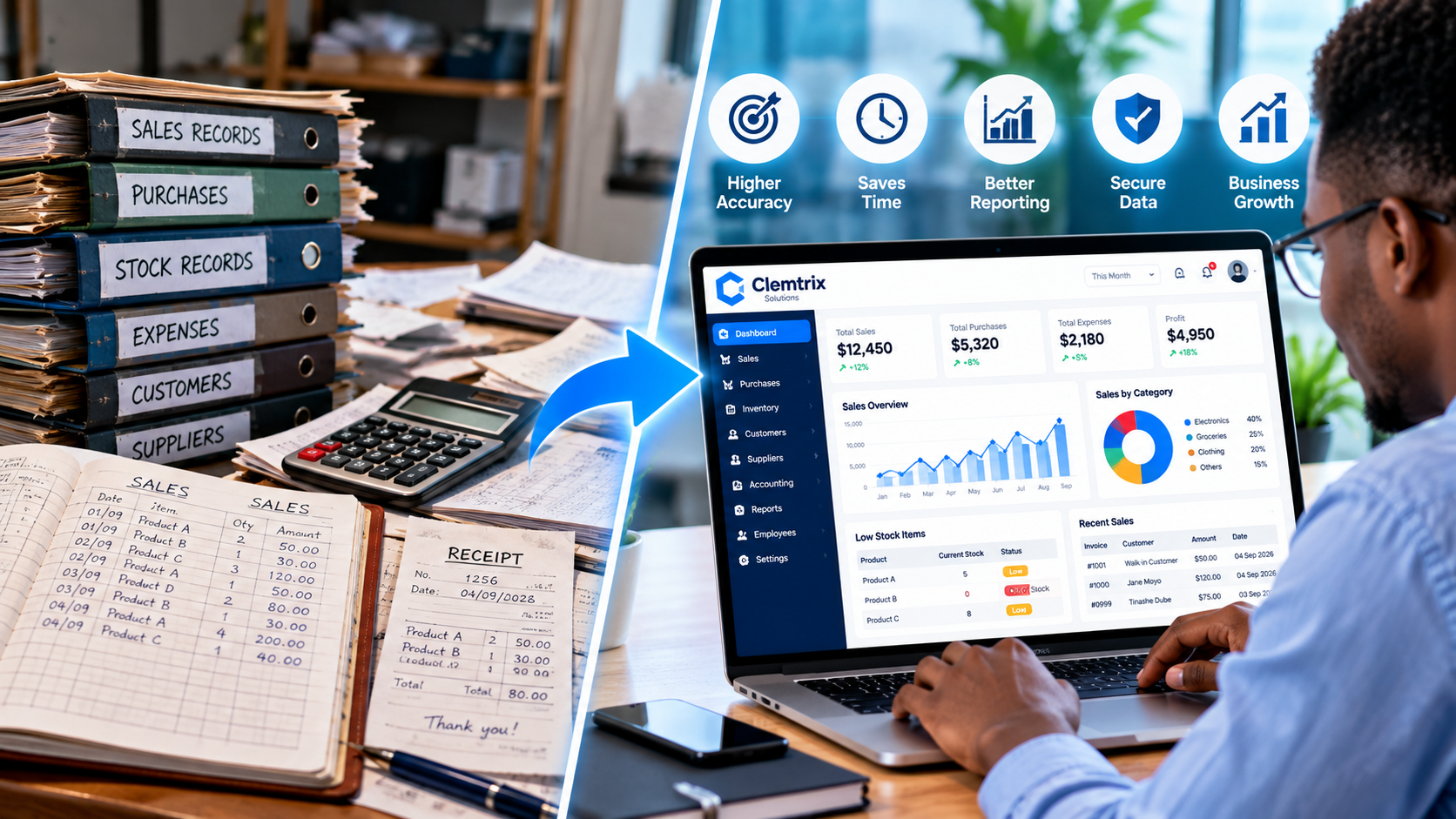
Many businesses begin by recording information in notebooks, receipt books, spreadsheets, filing cabinets, or handwritten ledgers.
At an early stage, these methods may appear inexpensive and manageable. However, as a business grows, the amount of information that must be recorded, checked, updated, and reported also increases.
Sales records, customer information, stock levels, expenses, employee records, supplier balances, invoices, and payments can quickly become difficult to manage manually.
Moving from manual records to business software allows organisations to manage this information more efficiently, accurately, and securely.
1. Manual Records Become Difficult to Manage as a Business Grows
Manual systems often work when transaction volumes are low.
As the number of customers, products, employees, suppliers, and transactions increases, however, business owners may find themselves maintaining several books, files, and spreadsheets.
This can create problems such as:
- Duplicate records
- Missing information
- Incorrect calculations
- Lost documents
- Delayed updates
- Difficulty finding previous transactions
- Inconsistent information between departments
Software allows information to be stored in a structured system where records can be searched, updated, and retrieved more easily.
2. Software Reduces Human Error
Manual calculations are vulnerable to mistakes.
For example, an employee may:
- Enter the wrong quantity
- Calculate a total incorrectly
- Record a transaction twice
- Forget to update stock
- Misplace a payment record
- Use the wrong price
- Transfer information incorrectly between books
Even small mistakes can affect financial reports and business decisions.
Business software can automate many calculations and validation processes.
A Point of Sale system, for example, can automatically calculate totals, taxes, discounts, payments, and customer change.
Inventory software can automatically adjust stock when goods are sold or received.
This reduces the amount of repetitive manual calculation required from employees.
3. Information Becomes Easier to Find
Finding information in physical records can take time.
A customer may ask for a transaction that occurred several months ago, requiring someone to search through receipt books, folders, or archived files.
With software, authorised users can search using information such as:
- Customer name
- Invoice number
- Receipt number
- Product
- Transaction date
- Supplier
- Employee
- Payment reference
The required record can often be retrieved within seconds.
This can significantly improve customer service and internal efficiency.
4. Business Owners Gain Better Visibility
One of the biggest disadvantages of manual record-keeping is that business information is often fragmented.
Sales may be stored in one book, expenses in another, stock in another, and employee information somewhere else.
This makes it difficult for management to understand the overall state of the business.
Business software can bring important information into dashboards and reports.
Management may be able to view:
- Daily sales
- Monthly revenue
- Expenses
- Outstanding payments
- Stock levels
- Best-selling products
- Low-stock products
- Supplier balances
- Employee costs
- Profitability trends
Having this information available makes it easier to understand what is happening in the business.
5. Reporting Becomes Faster
Preparing reports manually can require hours or even days of reviewing documents and performing calculations.
Software can generate many reports automatically.
Depending on the system, businesses may generate reports such as:
- Sales reports
- Expense reports
- Stock reports
- Profit and loss reports
- Customer statements
- Supplier statements
- Payroll reports
- Cash-flow reports
- Tax summaries
- Employee reports
Reports can also be generated for specific time periods, such as daily, weekly, monthly, quarterly, or annually.
This gives management information that can support planning and decision-making.
6. Software Improves Stock Control
Manual inventory management can become particularly difficult.
If stock movements are not recorded immediately, the quantity written in a stock book may no longer match the actual quantity available.
This can result in:
- Stock shortages
- Overstocking
- Unexpected product shortages
- Incorrect purchasing decisions
- Lost sales
- Difficulty identifying stock losses
Inventory software can record stock movements whenever products are purchased, sold, transferred, returned, or adjusted.
The system can also provide low-stock alerts and inventory reports.
This helps businesses maintain more accurate stock information.
7. Customer Records Can Be Managed More Effectively
Businesses often need to maintain information about their customers.
Manual customer records may be scattered across notebooks, phones, messaging platforms, invoices, and spreadsheets.
Software can centralise customer information such as:
- Contact details
- Purchase history
- Quotations
- Invoices
- Payments
- Outstanding balances
- Support requests
- Previous communication
This provides employees with a more complete picture of the customer relationship.
It can also improve follow-up and customer service.
8. Financial Records Become More Organised
Financial management is one of the areas where manual systems can create serious difficulties.
Business owners need accurate information about:
- Sales
- Purchases
- Expenses
- Income
- Payments
- Debtors
- Creditors
- Cash movement
- Bank transactions
When these records are maintained manually, reconciliation can become complicated.
Accounting and ERP software can help organise financial transactions and produce consistent financial reports.
This does not remove the need for proper accounting controls, but it makes financial information easier to manage and review.
9. Software Can Improve Data Security
Physical documents can be damaged, misplaced, stolen, or destroyed.
For example, important records can be lost through:
- Fire
- Water damage
- Theft
- Accidental disposal
- Misfiling
- Physical deterioration
Digital systems can include protections such as:
- User accounts
- Passwords
- Role-based permissions
- Database backups
- Audit logs
- Encryption
- Secure cloud storage
- Recovery procedures
Businesses can also restrict employees so that they only access the information required for their responsibilities.
However, digital systems must also be properly secured and maintained. Software should therefore be supported by strong passwords, backups, access controls, and cybersecurity practices.
10. Accountability Can Be Improved
In a manual system, it may be difficult to determine who changed or recorded specific information.
Modern business software can maintain audit trails.
An audit trail may record:
- Who created a transaction
- Who changed it
- When it was changed
- Who approved it
- What information was modified
This can improve accountability within the organisation.
It can also help management investigate mistakes or unusual activity.
11. Different Departments Can Work from the Same Information
In many businesses, departments maintain separate records.
For example:
- Sales maintains customer transactions.
- Stores maintains stock records.
- Finance maintains payments.
- Human resources maintains employee information.
- Management maintains reports.
If these records are managed separately, information may become inconsistent.
Integrated systems such as ERP software allow different departments to work with connected information.
For example, when a sale is completed:
1. The sales transaction is recorded.
2. Stock is reduced.
3. Revenue is recorded.
4. A receipt is generated.
5. The transaction becomes available for reporting.
This reduces the need to enter the same information into several different systems.
12. Software Saves Time
Administrative work consumes a significant amount of business time.
Employees may spend hours:
- Adding figures
- Writing receipts
- Updating stock books
- Searching files
- Preparing reports
- Checking balances
- Copying information between documents
Software automates many of these repetitive activities.
Employees can therefore spend more time on productive tasks such as customer service, sales, operations, and business development.
13. Business Decisions Can Be Based on Better Information
Good business decisions depend on reliable information.
If records are incomplete or outdated, managers may struggle to answer important questions.
For example:
- Which products are selling the most?
- Which products generate the highest profit?
- How much stock is currently available?
- How much money do customers owe?
- Which expenses are increasing?
- Which branches are performing best?
- How much revenue was generated this month?
Business software can provide this information through real-time dashboards and reports.
This allows decisions to be based more on recorded data rather than assumptions.
14. Software Makes Growth Easier to Manage
Business growth increases operational complexity.
A business that once had:
- One employee
- One location
- A few customers
- A small number of products
may eventually have several employees, multiple branches, thousands of transactions, and a large customer base.
Manual systems often struggle to scale with this growth.
Software can support additional:
- Users
- Branches
- Products
- Customers
- Transactions
- Departments
- Devices
A properly designed system can therefore grow together with the organisation.
15. Software Supports Remote and Multi-Branch Operations
Physical record books normally remain in one location.
This becomes inconvenient when a business operates from several branches.
Cloud-based and connected business systems can allow authorised users to access information from different locations.
For example, management at head office may be able to review sales from several branches without physically collecting sales books.
This creates better visibility across the organisation.
Does Moving to Software Mean Removing All Paper?
Not necessarily.
Some businesses may still require printed receipts, signed documents, statutory records, or physical supporting documentation.
The objective of digitalisation is not simply to eliminate paper.
The goal is to ensure that core business information is managed in a structured, searchable, secure, and reliable system.
Businesses can therefore use a combination of digital systems and necessary physical documentation.
Choosing the Right Business Software
Businesses should not adopt software simply because it is available.
The system should match the organisation's actual processes.
Before implementing software, businesses should consider:
- Business size
- Number of employees
- Number of branches
- Existing workflows
- Reporting requirements
- Security requirements
- Required integrations
- Internet availability
- Offline requirements
- Budget
- Future expansion
The right solution may be a simple accounting system, Point of Sale application, inventory system, Customer Relationship Management platform, or a complete Enterprise Resource Planning system.
Moving Gradually Can Be Better
Digital transformation does not always need to happen at once.
A small business may begin by computerising one important area, such as sales and inventory.
Later, it can introduce:
- Accounting
- Customer management
- Purchasing
- Payroll
- Human resources
- Reporting
- Online sales
- Business analytics
A phased approach can make implementation easier for both employees and management.
Final Thoughts
Manual record-keeping may be sufficient during the earliest stages of a business, but it becomes increasingly difficult to manage as operations grow.
Business software can improve accuracy, efficiency, security, reporting, accountability, and management visibility.
More importantly, digital records give businesses better control over their information.
Moving from manual records to software should therefore not be viewed simply as replacing books with computers. It is part of building a more structured, measurable, and scalable business operation.
For growing businesses, the question is increasingly not whether they should digitalise their records, but how they can implement the right digital systems in a way that supports their operations and future growth.
Many businesses begin by recording information in notebooks, receipt books, spreadsheets, filing cabinets, or handwritten ledgers.
At an early stage, these methods may appear inexpensive and manageable. However, as a business grows, the amount of information that must be recorded, checked, updated, and reported also increases.
Sales records, customer information, stock levels, expenses, employee records, supplier balances, invoices, and payments can quickly become difficult to manage manually.
Moving from manual records to business software allows organisations to manage this information more efficiently, accurately, and securely.
1. Manual Records Become Difficult to Manage as a Business Grows
Manual systems often work when transaction volumes are low.
As the number of customers, products, employees, suppliers, and transactions increases, however, business owners may find themselves maintaining several books, files, and spreadsheets.
This can create problems such as:
- Duplicate records
- Missing information
- Incorrect calculations
- Lost documents
- Delayed updates
- Difficulty finding previous transactions
- Inconsistent information between departments
Software allows information to be stored in a structured system where records can be searched, updated, and retrieved more easily.
2. Software Reduces Human Error
Manual calculations are vulnerable to mistakes.
For example, an employee may:
- Enter the wrong quantity
- Calculate a total incorrectly
- Record a transaction twice
- Forget to update stock
- Misplace a payment record
- Use the wrong price
- Transfer information incorrectly between books
Even small mistakes can affect financial reports and business decisions.
Business software can automate many calculations and validation processes.
A Point of Sale system, for example, can automatically calculate totals, taxes, discounts, payments, and customer change.
Inventory software can automatically adjust stock when goods are sold or received.
This reduces the amount of repetitive manual calculation required from employees.
3. Information Becomes Easier to Find
Finding information in physical records can take time.
A customer may ask for a transaction that occurred several months ago, requiring someone to search through receipt books, folders, or archived files.
With software, authorised users can search using information such as:
- Customer name
- Invoice number
- Receipt number
- Product
- Transaction date
- Supplier
- Employee
- Payment reference
The required record can often be retrieved within seconds.
This can significantly improve customer service and internal efficiency.
4. Business Owners Gain Better Visibility
One of the biggest disadvantages of manual record-keeping is that business information is often fragmented.
Sales may be stored in one book, expenses in another, stock in another, and employee information somewhere else.
This makes it difficult for management to understand the overall state of the business.
Business software can bring important information into dashboards and reports.
Management may be able to view:
- Daily sales
- Monthly revenue
- Expenses
- Outstanding payments
- Stock levels
- Best-selling products
- Low-stock products
- Supplier balances
- Employee costs
- Profitability trends
Having this information available makes it easier to understand what is happening in the business.
5. Reporting Becomes Faster
Preparing reports manually can require hours or even days of reviewing documents and performing calculations.
Software can generate many reports automatically.
Depending on the system, businesses may generate reports such as:
- Sales reports
- Expense reports
- Stock reports
- Profit and loss reports
- Customer statements
- Supplier statements
- Payroll reports
- Cash-flow reports
- Tax summaries
- Employee reports
Reports can also be generated for specific time periods, such as daily, weekly, monthly, quarterly, or annually.
This gives management information that can support planning and decision-making.
6. Software Improves Stock Control
Manual inventory management can become particularly difficult.
If stock movements are not recorded immediately, the quantity written in a stock book may no longer match the actual quantity available.
This can result in:
- Stock shortages
- Overstocking
- Unexpected product shortages
- Incorrect purchasing decisions
- Lost sales
- Difficulty identifying stock losses
Inventory software can record stock movements whenever products are purchased, sold, transferred, returned, or adjusted.
The system can also provide low-stock alerts and inventory reports.
This helps businesses maintain more accurate stock information.
7. Customer Records Can Be Managed More Effectively
Businesses often need to maintain information about their customers.
Manual customer records may be scattered across notebooks, phones, messaging platforms, invoices, and spreadsheets.
Software can centralise customer information such as:
- Contact details
- Purchase history
- Quotations
- Invoices
- Payments
- Outstanding balances
- Support requests
- Previous communication
This provides employees with a more complete picture of the customer relationship.
It can also improve follow-up and customer service.
8. Financial Records Become More Organised
Financial management is one of the areas where manual systems can create serious difficulties.
Business owners need accurate information about:
- Sales
- Purchases
- Expenses
- Income
- Payments
- Debtors
- Creditors
- Cash movement
- Bank transactions
When these records are maintained manually, reconciliation can become complicated.
Accounting and ERP software can help organise financial transactions and produce consistent financial reports.
This does not remove the need for proper accounting controls, but it makes financial information easier to manage and review.
9. Software Can Improve Data Security
Physical documents can be damaged, misplaced, stolen, or destroyed.
For example, important records can be lost through:
- Fire
- Water damage
- Theft
- Accidental disposal
- Misfiling
- Physical deterioration
Digital systems can include protections such as:
- User accounts
- Passwords
- Role-based permissions
- Database backups
- Audit logs
- Encryption
- Secure cloud storage
- Recovery procedures
Businesses can also restrict employees so that they only access the information required for their responsibilities.
However, digital systems must also be properly secured and maintained. Software should therefore be supported by strong passwords, backups, access controls, and cybersecurity practices.
10. Accountability Can Be Improved
In a manual system, it may be difficult to determine who changed or recorded specific information.
Modern business software can maintain audit trails.
An audit trail may record:
- Who created a transaction
- Who changed it
- When it was changed
- Who approved it
- What information was modified
This can improve accountability within the organisation.
It can also help management investigate mistakes or unusual activity.
11. Different Departments Can Work from the Same Information
In many businesses, departments maintain separate records.
For example:
- Sales maintains customer transactions.
- Stores maintains stock records.
- Finance maintains payments.
- Human resources maintains employee information.
- Management maintains reports.
If these records are managed separately, information may become inconsistent.
Integrated systems such as ERP software allow different departments to work with connected information.
For example, when a sale is completed:
1. The sales transaction is recorded.
2. Stock is reduced.
3. Revenue is recorded.
4. A receipt is generated.
5. The transaction becomes available for reporting.
This reduces the need to enter the same information into several different systems.
12. Software Saves Time
Administrative work consumes a significant amount of business time.
Employees may spend hours:
- Adding figures
- Writing receipts
- Updating stock books
- Searching files
- Preparing reports
- Checking balances
- Copying information between documents
Software automates many of these repetitive activities.
Employees can therefore spend more time on productive tasks such as customer service, sales, operations, and business development.
13. Business Decisions Can Be Based on Better Information
Good business decisions depend on reliable information.
If records are incomplete or outdated, managers may struggle to answer important questions.
For example:
- Which products are selling the most?
- Which products generate the highest profit?
- How much stock is currently available?
- How much money do customers owe?
- Which expenses are increasing?
- Which branches are performing best?
- How much revenue was generated this month?
Business software can provide this information through real-time dashboards and reports.
This allows decisions to be based more on recorded data rather than assumptions.
14. Software Makes Growth Easier to Manage
Business growth increases operational complexity.
A business that once had:
- One employee
- One location
- A few customers
- A small number of products
may eventually have several employees, multiple branches, thousands of transactions, and a large customer base.
Manual systems often struggle to scale with this growth.
Software can support additional:
- Users
- Branches
- Products
- Customers
- Transactions
- Departments
- Devices
A properly designed system can therefore grow together with the organisation.
15. Software Supports Remote and Multi-Branch Operations
Physical record books normally remain in one location.
This becomes inconvenient when a business operates from several branches.
Cloud-based and connected business systems can allow authorised users to access information from different locations.
For example, management at head office may be able to review sales from several branches without physically collecting sales books.
This creates better visibility across the organisation.
Does Moving to Software Mean Removing All Paper?
Not necessarily.
Some businesses may still require printed receipts, signed documents, statutory records, or physical supporting documentation.
The objective of digitalisation is not simply to eliminate paper.
The goal is to ensure that core business information is managed in a structured, searchable, secure, and reliable system.
Businesses can therefore use a combination of digital systems and necessary physical documentation.
Choosing the Right Business Software
Businesses should not adopt software simply because it is available.
The system should match the organisation's actual processes.
Before implementing software, businesses should consider:
- Business size
- Number of employees
- Number of branches
- Existing workflows
- Reporting requirements
- Security requirements
- Required integrations
- Internet availability
- Offline requirements
- Budget
- Future expansion
The right solution may be a simple accounting system, Point of Sale application, inventory system, Customer Relationship Management platform, or a complete Enterprise Resource Planning system.
Moving Gradually Can Be Better
Digital transformation does not always need to happen at once.
A small business may begin by computerising one important area, such as sales and inventory.
Later, it can introduce:
- Accounting
- Customer management
- Purchasing
- Payroll
- Human resources
- Reporting
- Online sales
- Business analytics
A phased approach can make implementation easier for both employees and management.
Final Thoughts
Manual record-keeping may be sufficient during the earliest stages of a business, but it becomes increasingly difficult to manage as operations grow.
Business software can improve accuracy, efficiency, security, reporting, accountability, and management visibility.
More importantly, digital records give businesses better control over their information.
Moving from manual records to software should therefore not be viewed simply as replacing books with computers. It is part of building a more structured, measurable, and scalable business operation.
For growing businesses, the question is increasingly not whether they should digitalise their records, but how they can implement the right digital systems in a way that supports their operations and future growth.